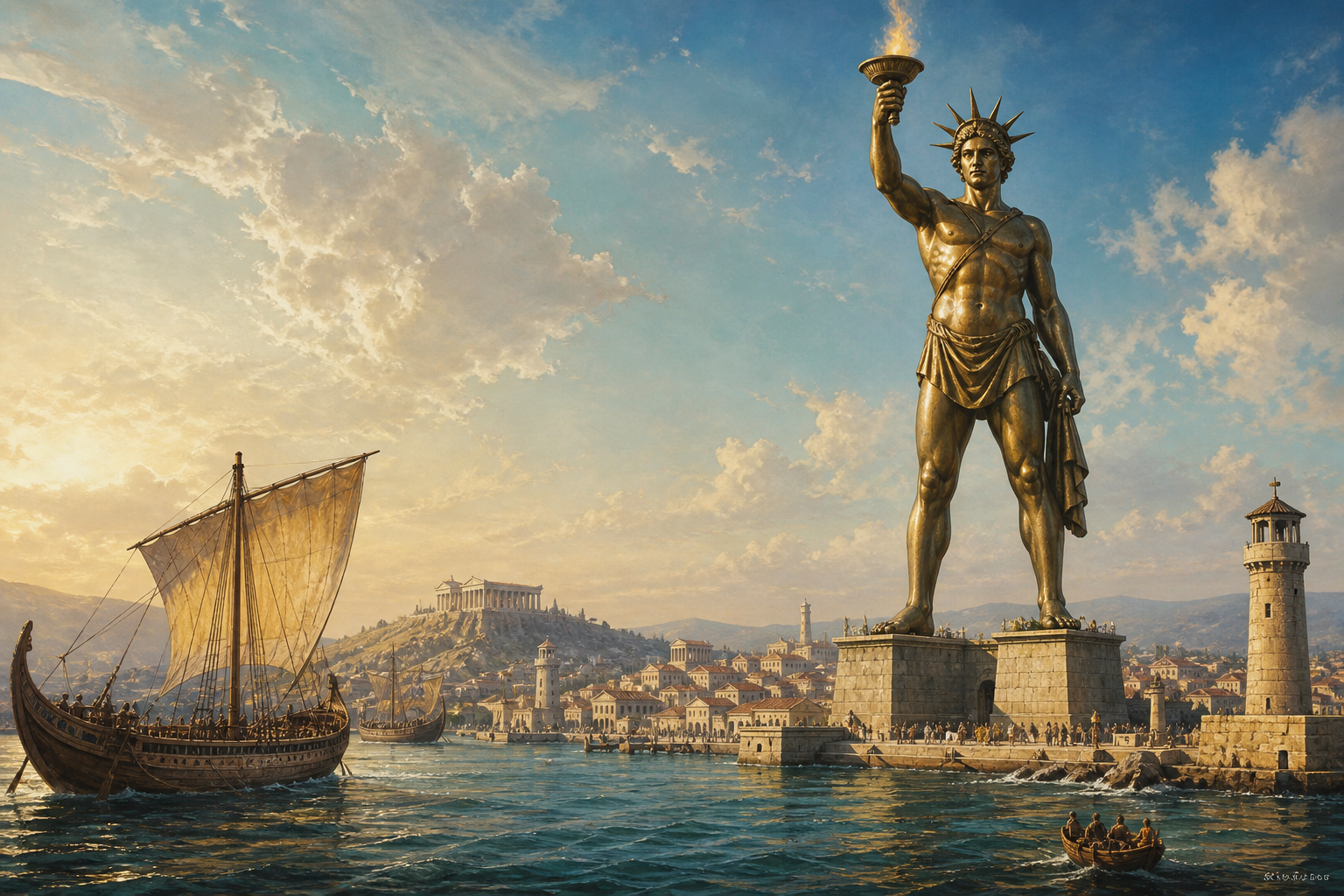
Colossus of Rhodes belongs to the years before the Common Era — dated here to c. 280 BCE at Rhodes harbour. The date is a scholarly centre of gravity, not a foundation-stone timestamp.
Chares of Lindos cast Helios roughly 33 metres high to thank the sun god after Demetrius failed to take the island.
How it was made
Bronze plates on an iron frame stood beside the harbour — not astride it, despite later engravings. An earthquake dropped it after about 54 years.
Why it still counts as a wonder
It sits on the canonical Greek list of seven wonders of the ancient world — a tourist poster already in Hellenistic poetry.
The wreck lay on the ground for centuries. The wonder is the scale of Hellenistic bronze, not a ship sailing between bronze shins.
On dating
BCE in this series means years before the traditional birth of Christ, counted backward. A monument listed as c. 280 BCE may have been founded earlier, rebuilt later, or famous only in one phase. Where ancient writers disagree — as they do for Babylon’s gardens — we say so.
This is story 6 of 100 in The Trend Ledger’s illustrated desk on world wonders raised before the Common Era.