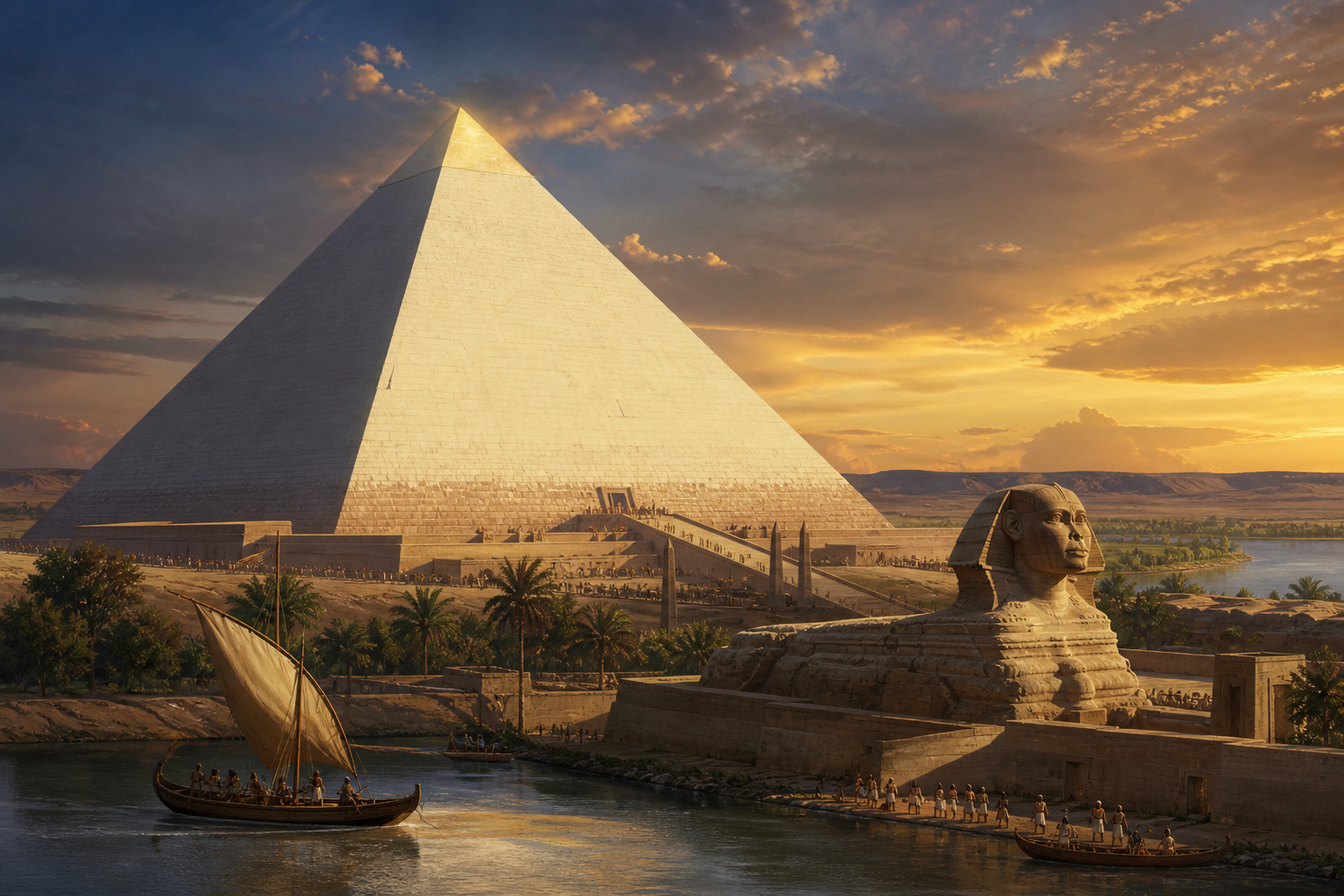
Great Pyramid of Giza belongs to the years before the Common Era — dated here to c. 2560 BCE at Giza, Egypt. The date is a scholarly centre of gravity, not a foundation-stone timestamp.
Khufu’s pyramid was the tallest human-made structure on Earth for nearly 3,800 years, with about 2.3 million limestone blocks.
How it was made
Casing stones were dressed so tightly that a knife blade still struggles at the joints that survive. Inner relieving chambers keep the King’s Chamber from crushing.
Why it still counts as a wonder
It sits on the canonical Greek list of seven wonders of the ancient world — a tourist poster already in Hellenistic poetry.
The polished white casing is mostly gone; the core still holds the plateau. It is the only ancient “Seven Wonder” still largely intact.
On dating
BCE in this series means years before the traditional birth of Christ, counted backward. A monument listed as c. 2560 BCE may have been founded earlier, rebuilt later, or famous only in one phase. Where ancient writers disagree — as they do for Babylon’s gardens — we say so.
This is story 1 of 100 in The Trend Ledger’s illustrated desk on world wonders raised before the Common Era.